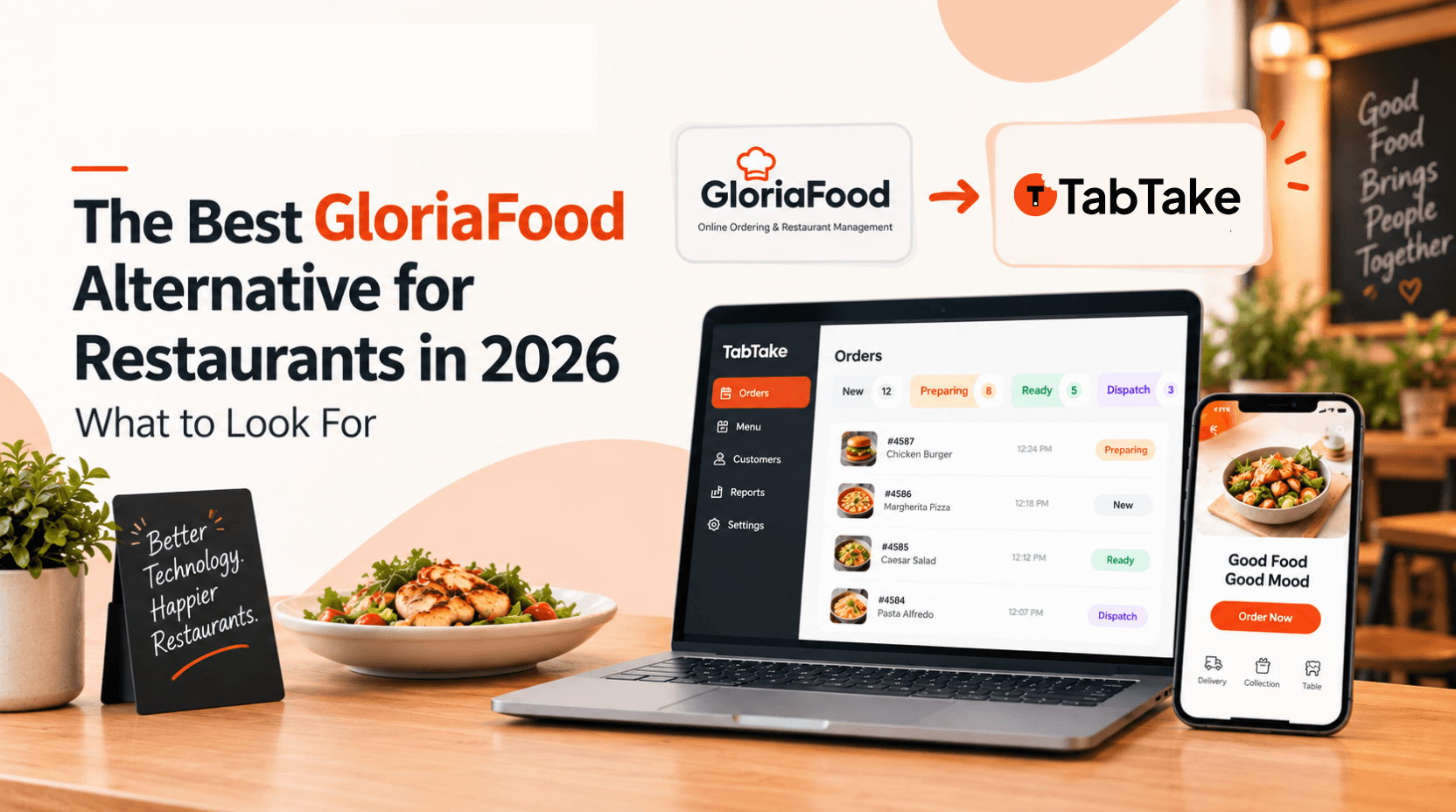
GloriaFood has been a popular restaurant online ordering solution, helping businesses accept orders through their own digital channels. However, GloriaFood has announced that its service will reach end of life on April 30, 2027, giving restaurant owners time to evaluate their options and plan their next step.
For restaurants that rely on online ordering, this is more than a software change. Your ordering platform can affect how customers discover your menu, place orders, receive updates, and interact with your restaurant.
So, what should restaurants look for in a GloriaFood alternative?
What Should a GloriaFood Alternative Offer?
Replacing an online ordering system is an opportunity to review the entire ordering and operational workflow rather than simply finding another way to receive online orders.
A modern restaurant ordering platform should ideally bring together the customer experience and the restaurant's day-to-day operations.
Here are some of the key areas to consider.
1. Direct Online Ordering
One of the most important features is the ability to accept orders directly through your own restaurant website or branded ordering experience.
Direct ordering gives customers a clear path from browsing your menu to selecting collection or delivery and completing checkout.
TabTake provides a branded online ordering experience that supports direct collection and delivery orders, scheduled ordering, menu management, payments, and restaurant operations.
For restaurants moving away from an existing ordering platform, maintaining a reliable direct ordering channel should be one of the first priorities.
2. A Branded Restaurant Experience
Your ordering platform should feel like part of your restaurant rather than a disconnected third-party experience.
A branded storefront can help maintain consistency across your website, menu, offers, and ordering journey.
TabTake allows restaurants to create a branded storefront connected to their menu and direct ordering experience.
This means customers can move from discovering your restaurant to browsing the menu and placing an order within a connected experience.
3. Delivery and Collection Ordering
Restaurants have different fulfilment needs. Some customers want delivery, while others prefer to collect their food.
A replacement platform should support the ordering methods your restaurant actually uses.
TabTake supports both delivery and collection ordering, with options for delivery details, service areas, preparation times, and collection workflows.
This allows restaurants to manage different fulfilment journeys without creating separate ordering experiences for every service.
4. Scheduled Orders
Customers do not always want their food immediately.
For example, someone might place a lunch order in the morning for collection at 1:00 PM. Restaurants therefore benefit from an ordering system that can support available future ordering times.
TabTake includes scheduled ordering, allowing restaurants to offer supported future collection and delivery times.
Scheduled ordering can also help restaurant teams prepare for upcoming demand.
5. Centralized Menu Management
A restaurant menu is constantly changing.
Prices change. Products sell out. Seasonal items are introduced. New modifiers are added. Opening hours and availability can also vary.
A modern GloriaFood alternative should make these changes easy to manage.
TabTake's menu management tools allow restaurants to manage categories, products, pricing, modifiers, availability, schedules, and location settings from one connected workspace.
Keeping menu information centralised can make it easier for restaurant teams to maintain accurate customer-facing information.
6. A Clear Order Management Workflow
Taking an online order is only the beginning.
Once an order arrives, restaurant staff need to know:
What has been ordered?
Is the order new or accepted?
Is the kitchen preparing it?
Is it ready?
Is it waiting for collection or delivery?
Has it been completed?
TabTake provides a central order workflow where teams can view incoming orders and move them through statuses such as new, accepted, preparing, ready, completed, and cancelled.
A clear workflow can help front-of-house and kitchen teams stay aligned as orders move from checkout to fulfilment.
7. Kitchen Connectivity
The customer-facing ordering experience should connect with what happens behind the scenes.
If staff have to manually transfer every online order into another system, the restaurant may create unnecessary work and opportunities for mistakes.
TabTake connects online ordering with kitchen workflows and supports kitchen printing as part of its restaurant operations platform.
When evaluating a replacement, restaurants should therefore look beyond the ordering page and consider the complete journey from customer checkout to kitchen preparation.
8. Customer Data and Relationships
Your online ordering platform is also part of your customer relationship.
Restaurants should consider how customer and order information can support future engagement, loyalty, promotions, and repeat ordering.
TabTake includes customer CRM, customer analytics, promotions, and loyalty tools designed to connect direct ordering with customer growth.
This can help restaurants think beyond individual orders and build a longer-term direct relationship with their customers.
9. QR Ordering
A replacement for an online ordering system does not necessarily need to stop at website ordering.
For restaurants with dine-in service, QR ordering can provide another digital ordering channel.
TabTake's QR Table Ordering allows guests to scan a table QR code, browse the menu, customise items, and place orders from their own devices. Orders can remain connected to the relevant table, location, kitchen workflow, and order dashboard.
This makes QR ordering another part of a broader restaurant ordering ecosystem.
10. Multi-Location Management
A system that works for one restaurant may become difficult to manage when a business expands.
Restaurant groups may need to manage multiple menus, locations, teams, settings, and reports while maintaining consistent brand standards.
TabTake supports multi-location management, allowing restaurant groups to manage locations from a central platform while retaining location-level control.
When choosing a GloriaFood alternative, growing businesses should therefore consider not only what they need today but also how the platform can support future locations.
Why Restaurants Should Start Planning Early
The announced GloriaFood end-of-life date is April 30, 2027.
That gives restaurants time to approach the transition carefully instead of waiting until the final months.
A planned migration can give your team time to:
Review your current ordering workflow.
Identify the features your restaurant actually uses.
Compare alternative platforms.
Prepare your menu and business information.
Test the customer ordering journey.
Train restaurant staff.
Check kitchen and fulfilment workflows.
Launch the new system before the existing service ends.
The goal should not simply be to replace one login with another. It should be to build an ordering workflow that fits how your restaurant operates today.
Why Consider TabTake?
TabTake is built as a connected restaurant ordering and operations platform rather than only a customer-facing ordering page.
Its platform brings together direct online ordering, branded storefronts, delivery, collection, scheduled orders, QR ordering, menus, kitchen workflows, customer tools, reservations, analytics, and multi-location management.
For restaurants evaluating their options after GloriaFood, this provides a way to consider online ordering together with the operational systems behind it.
With TabTake, restaurants can create a branded direct ordering channel while connecting orders to menus, fulfilment, kitchen operations, customer information, and reporting.
What to Check Before Choosing Your Next Platform
Before moving from GloriaFood to another restaurant ordering system, create a checklist based on your actual business requirements.
Ask:
Customer Experience
Can customers order directly from our website?
Is the ordering experience mobile-friendly?
Can customers choose delivery or collection?
Can customers schedule orders?
Can customers order through QR codes where needed?
Restaurant Operations
Can staff manage orders from one dashboard?
Can orders connect to the kitchen?
Can menus and availability be updated easily?
Can staff clearly see order statuses?
Business Growth
Can we access useful customer and order information?
Are promotions and loyalty supported?
Can we manage multiple locations?
Can the platform grow with our restaurant?
Migration
Can our team learn the system easily?
Can we test the complete customer journey before launch?
Can we prepare our menu and settings before switching?
Is support available during setup?
The answers will help you identify whether a platform is genuinely suitable for your restaurant rather than simply checking whether it has an online ordering button.
Final Thoughts
GloriaFood's announced end-of-life date means restaurant owners have a clear reason to review their online ordering setup and plan ahead.
The right replacement should do more than accept online orders. It should provide a reliable customer experience while connecting ordering with menus, kitchen workflows, fulfilment, customer relationships, and restaurant operations.
For restaurants looking for a modern alternative, TabTake brings direct ordering, branded storefronts, delivery, collection, scheduled orders, QR ordering, menu management, customer tools, and multi-location capabilities into one connected restaurant platform.
If you're currently using GloriaFood, now is a practical time to review your requirements, compare alternatives, and start planning the transition before the April 30, 2027 end-of-life date.
Ready to Explore a GloriaFood Alternative?
Explore TabTake to see how your restaurant can build a direct ordering experience connected to everyday restaurant operations.