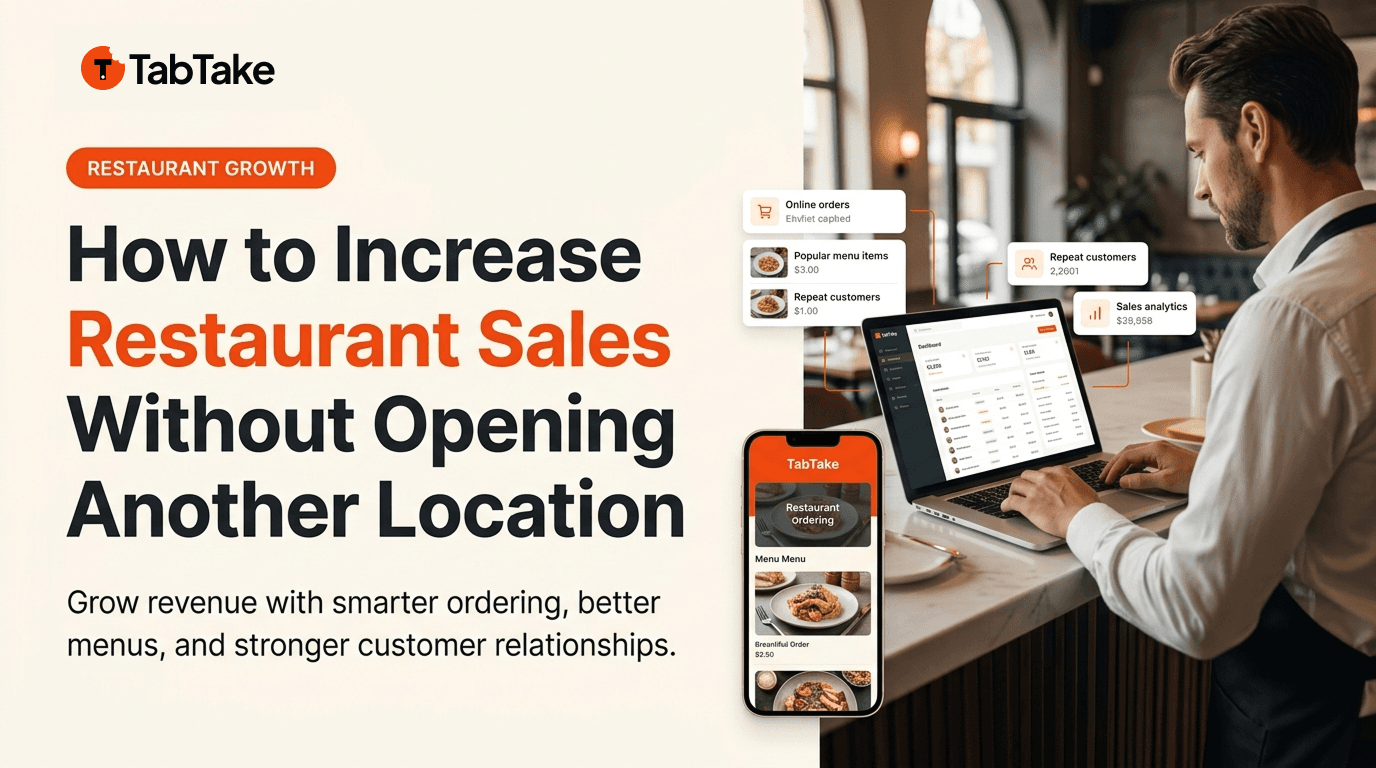
Opening another restaurant is one way to grow a food business, but it is not the only way. For many restaurant owners, the bigger opportunity is to generate more revenue from the customers, menu, ordering channels, and operational capacity they already have.
The question is how to increase restaurant sales without adding the cost and complexity of another location.
The answer starts with understanding where growth can come from. Restaurants can improve the way customers discover their business, make ordering more convenient, increase average order value, encourage repeat visits, and use sales data to make better decisions.
Restaurant growth does not always require a bigger operation. Sometimes, it requires making the existing one work better.
What Is the Best Way to Increase Restaurant Sales?
The most effective way to increase restaurant sales is to improve several parts of the customer journey together: attract more relevant customers, convert more visitors into paying customers, increase the value of each order, and give existing customers reasons to return.
For some restaurants, the biggest opportunity is a better online ordering experience. For others, it may be improving menu presentation, introducing carefully planned promotions, encouraging repeat purchases, or making collection and delivery easier.
Before investing in new equipment, another location, or a larger marketing budget, restaurant owners should understand which part of their current business is limiting growth.
That is where a more deliberate restaurant growth strategy begins.
Turn More Website Visitors into Paying Customers
A restaurant can have an attractive website and an active social media presence without generating as many orders as it could.
The difference often comes down to what customers can do when they arrive.
If someone discovers your restaurant online, they should be able to find the menu, understand the available options, check delivery or collection details, and place an order without unnecessary steps. Every extra obstacle creates another opportunity for a potential customer to leave.
Your restaurant website should do more than display your address, opening hours, and photographs. It should help customers take the next step.
A branded online ordering storefront gives customers a direct route from discovering your restaurant to completing a purchase. It also creates an opportunity to present your menu, prices, promotions, and brand consistently.
With TabTake, restaurants can connect their branded storefront with direct online ordering, menu management, supported payment options, and order workflows.
The objective is simple: make it easier for interested customers to become paying customers.
Increase Average Order Value Without Making Customers Spend Unnecessarily
One way to grow revenue without attracting an entirely new audience is to increase the average value of each order.
Average order value is the average amount customers spend per transaction. It helps restaurant owners understand how much revenue each order generates before accounting for costs.
For example, if a restaurant receives 1,000 orders in a month with an average order value of £20, it generates £20,000 in sales. If the same number of orders produces an average order value of £22, monthly sales reach £22,000.
That is £2,000 more in monthly sales, assuming order volume stays the same.
The challenge is increasing order value in a way that genuinely benefits the customer.
Thoughtful menu design can help. A restaurant might recommend a drink alongside a main course, make a suitable side dish easier to discover, offer a meal combination, or highlight a dessert that complements the customer's selection.
These suggestions should feel relevant rather than forced.
Digital menus make it easier to organise categories, present products clearly, display useful descriptions, and update featured items. Restaurants can also review product performance to understand which items customers choose and which combinations deserve further attention.
The goal is not simply to make every basket more expensive. It is to help customers discover products they genuinely want while improving the commercial performance of the menu.
Use Restaurant Promotions to Create More Valuable Demand
Discounts can generate attention, but not every promotion produces profitable growth.
A broad discount may encourage purchases that would have happened anyway. It can also reduce the amount the restaurant earns from each order without creating a lasting customer relationship.
A better approach is to begin with a clear business objective.
A restaurant with quiet weekday afternoons might test a limited-time lunch offer. A takeaway might introduce a minimum-spend promotion to encourage customers to add another item. A new restaurant might offer a first-order incentive, while an established business could create a campaign designed to encourage previous customers to return.
The offer should match the problem the restaurant is trying to solve.
Timing, eligibility, minimum order values, eligible products, and participating locations all influence how a promotion performs. Restaurant owners should also consider food costs, packaging, payment fees, delivery expenses, and other variable costs before deciding how much discount they can afford.
TabTake Promotions supports configurable offers and scheduling, with supported promotion activity available for review. This helps restaurants manage campaigns with clearer rules rather than relying on informal, difficult-to-measure discounts.
A successful promotion should have a purpose, a defined audience, and a way to evaluate its results.
Turn First-Time Customers into Repeat Customers
Acquiring a new customer can require time, marketing effort, and promotional spending. That is why repeat business deserves as much attention as customer acquisition.
A customer who has already enjoyed your food and service has a reason to consider ordering again. The restaurant's job is to make that next order convenient and worthwhile.
A reliable online ordering experience, consistent food quality, relevant offers, and a recognisable brand all contribute to repeat business. Loyalty programmes can provide an additional reason to return by rewarding eligible purchases with points, stamps, or other clearly defined benefits.
However, loyalty is not created by rewards alone. Customers return when the overall experience meets their expectations.
Restaurants should consider how easy it is to reorder, whether their favourite products remain available, whether promotions are relevant, and whether the service experience remains consistent.
TabTake brings together supported loyalty, customer CRM, promotions, and customer analytics capabilities. These tools can help restaurants understand customer activity and build more organised retention strategies.
The long-term opportunity is to develop a customer base that chooses your restaurant repeatedly, rather than depending entirely on continually finding new buyers.
Make Direct Online Ordering Part of Your Growth Strategy
Third-party delivery marketplaces can help restaurants reach people who might not otherwise discover them. But relying on a single external channel can limit a restaurant's control over its brand and customer journey.
Direct online ordering gives customers another way to buy from the restaurant through its own branded ordering channel.
This can be particularly valuable for restaurants that already have a customer base, a website, social media traffic, or regular collection and delivery demand.
A restaurant can promote its direct ordering link across its digital presence, packaging, receipts, and other appropriate customer touchpoints. Customers who already know the business have a convenient route back to its own menu.
Direct ordering should complement the restaurant's wider channel strategy, not be treated as an automatic replacement for every marketplace. Owners should evaluate commission arrangements, payment fees, fulfilment costs, marketing expenses, and the overall contribution each channel makes to the business.
TabTake supports branded direct ordering alongside delivery, collection, scheduled orders, and QR table ordering. This gives restaurants ways to connect different ordering occasions through their own digital experience.
More control over the ordering journey can support a stronger brand and a more direct customer relationship.
Make Your Menu Work Harder for Your Business
Your menu influences what customers notice, what they choose, and how much they spend.
A menu that is difficult to navigate can make ordering frustrating. Poor product descriptions may leave customers uncertain, while outdated prices or unavailable items can damage trust.
A well-organised digital menu makes the decision easier.
Start by reviewing which products attract the most orders, which generate the strongest contribution after relevant costs, and which items customers rarely choose. High sales do not always mean high profitability, so both demand and product economics matter.
Use clear categories, accurate descriptions, appealing product photography where appropriate, and sensible modifiers. Make popular combinations easy to discover without overwhelming customers with too many options.
Restaurants should also keep availability and pricing accurate across their supported ordering channels. When an item sells out or a price changes, customers should not continue seeing outdated information.
TabTake's menu management capabilities help restaurants maintain products, prices, modifiers, categories, and availability through a connected platform.
A menu should not remain unchanged simply because it was designed once. Reviewing its performance regularly gives restaurant owners a practical way to identify opportunities for improvement.
Use Restaurant Sales Data to Make Better Decisions
Growth becomes difficult to manage when decisions rely entirely on instinct.
A busy evening might feel successful, but it does not automatically reveal which products generated the strongest contribution, whether average order value improved, or whether customers are returning more frequently.
Restaurant owners need to look beyond total sales.
Useful measures include order volume, average order value, product performance, delivery versus collection activity, repeat-customer behaviour, promotion redemptions, and sales patterns by day or service period.
These metrics help answer different questions.
If order volume is increasing but revenue is not growing at the same pace, average order value may deserve attention. If sales rise during a promotion but fall sharply afterwards, the campaign may have shifted demand rather than generated sustained growth. If customers order frequently on weekends but rarely during quieter periods, there may be an opportunity to test a targeted campaign.
The important step is to connect the numbers to a decision.
TabTake's customer analytics and related reporting capabilities can help restaurants review supported ordering activity, customer behaviour, and channel trends. Restaurant owners can use those insights to identify patterns and test changes more deliberately.
Data does not make decisions for the restaurant. It helps the team ask better questions and evaluate whether its decisions are working.
Increase Sales Without Overloading Your Team
More orders are only valuable when the restaurant can handle them effectively.
If additional demand leads to missed orders, long preparation times, incorrect items, or overwhelmed staff, the customer experience can suffer. Operational problems can also increase waste and reduce the benefit of higher sales.
Before launching a campaign or expanding an ordering channel, restaurant owners should consider kitchen capacity, preparation times, staffing, stock availability, delivery coverage, and peak service periods.
Ordering systems should support the team's workflow rather than create another disconnected task.
A clear order dashboard, accurate menu availability, connected kitchen processes, and well-defined fulfilment settings can help staff manage incoming demand more consistently.
TabTake connects direct ordering with order management and supported kitchen workflows, helping restaurants coordinate the customer order with the work that follows.
Sustainable restaurant growth requires both sides of the equation: generating demand and fulfilling it well.
How to Build a Restaurant Sales Growth Plan
A restaurant does not need to change everything at once. In fact, testing a small number of improvements can make it easier to understand what actually works.
Begin by establishing your current position. Review sales, order volume, average order value, customer return patterns, product performance, and channel costs. Identify the biggest constraint rather than assuming that every area needs improvement.
Next, choose one clear objective. You might want to increase direct online orders, improve average order value, generate demand during quieter periods, or encourage existing customers to return.
Select an action that addresses that objective. This could mean improving the digital menu, introducing a carefully costed promotion, making the ordering link easier to find, or testing a loyalty initiative.
Then measure the result over an appropriate period. Compare like-for-like days or weeks where possible, account for seasonal effects, and consider the cost of the activity as well as the revenue it generates.
Once an approach shows promising results, refine it and decide whether it is worth expanding.
This process creates a more reliable foundation for growth than introducing several changes at the same time and hoping that sales improve.
How TabTake Can Support Restaurant Growth
Increasing restaurant sales involves more than attracting attention. Restaurants need a connected way to help customers discover the menu, place orders, complete payments, receive their food, and return for another purchase.
TabTake brings together tools for direct online ordering, branded storefronts, digital menu management, QR table ordering, delivery, collection, promotions, loyalty, customer CRM, analytics, and multi-location management.
The right combination depends on the restaurant's business model and current challenges. A takeaway may prioritise direct delivery and collection, while a dine-in restaurant may focus on QR ordering. A growing restaurant group may need centralised control over menus and locations.
The value comes from choosing tools that solve real operational and commercial problems, then using them consistently.
For restaurant owners who want to grow without immediately committing to another location, improving the existing customer journey is a practical place to start.
Frequently Asked Questions
How can I increase restaurant sales without opening another location?
Improve the performance of your existing restaurant by making online ordering easier, optimising your menu, increasing average order value, encouraging repeat customers, using targeted promotions, and reviewing sales data. Start with the area that offers the clearest opportunity for improvement.
What is the fastest way to increase restaurant revenue?
There is no single method that works for every restaurant. Improving conversion on an existing ordering channel, promoting suitable high-contribution products, or addressing a quiet service period may produce results sooner than building an entirely new sales channel. Measure the financial outcome rather than relying on order volume alone.
How can a restaurant increase average order value?
Restaurants can improve average order value through relevant add-ons, meal combinations, complementary products, clear menu presentation, and carefully designed minimum-spend offers. Any strategy should account for product costs and avoid pressuring customers into purchases they do not want.
Does online ordering help restaurants increase sales?
Online ordering gives customers a convenient way to browse menus and place orders outside the traditional in-person ordering journey. Its impact depends on customer demand, visibility, conversion, pricing, fulfilment capacity, and the costs associated with operating the channel.
How can restaurants encourage customers to order again?
Consistent food quality, reliable service, a convenient ordering experience, relevant promotions, and well-designed loyalty programmes can encourage repeat business. Restaurants should use available customer insights responsibly to understand purchasing patterns and improve the experience.
How can restaurant technology help increase sales?
Restaurant technology can connect digital menus, direct ordering, promotions, loyalty, customer records, and analytics. When configured around a restaurant's needs, these tools can help reduce friction, organise operations, and give owners better information for growth decisions.
Take the First Step Toward Your Dream Restaurant
Explore our solutions, test out live storefront themes, and see how TabTake can power your grand opening.